
OEM Jewelry Manufacturing: What a Tech Pack Must Contain
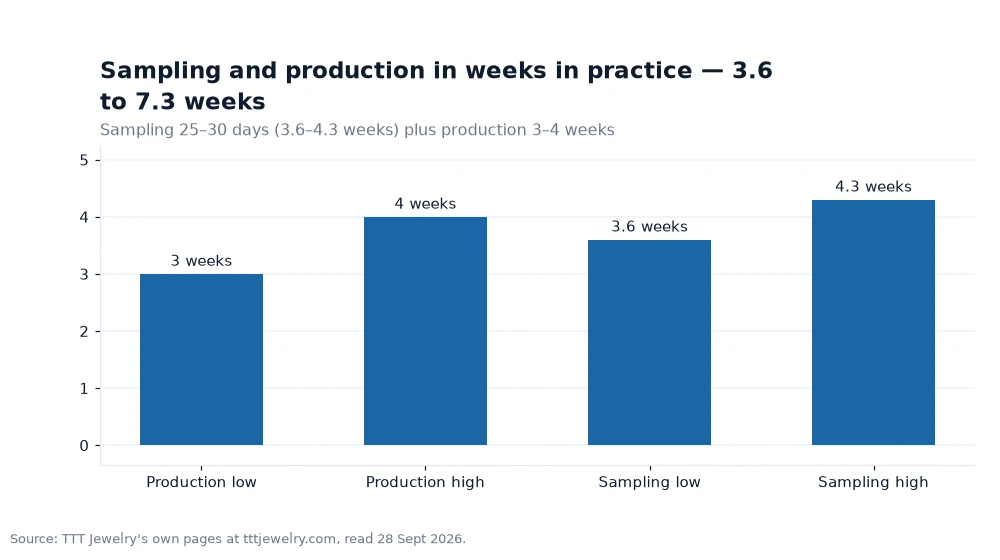
A tech pack is the difference between a quote and a guess. For a custom jewelry order it has to carry dimensions with tolerances, base metal, plating stack, stone sizes, hallmark placement and packaging — enough for a factory to build a CAD file without asking a question. In TTT Jewelry's OEM/ODM flow, an approved pack becomes a 3D model in under 48 hours and a master sample in 25–30 days, so the pack is the input that starts both clocks.

Key takeaways
- Six fields carry most of the risk: material, quantity, dimensions, plating, stones and packaging.
- A complete pack yields CAD in under 48 hours and a master sample in 25–30 days.
- Bench time runs 46–58 days before the 48-hour CAD stage is added.
- One blank field can add a 25–30 day resample, taking a 48-day order past 73 days.
The fields a factory reads first
A tech pack is read in a predictable order. Quantity and base metal come first, because they rule designs in or out before anyone looks at the artwork. Sterling silver starts at 50 pieces per design, artisan eco-brass at 100, stainless steel at 100 or more. A drawing for a 30-piece silver run is not a manufacturing question; it is a quantity problem.
Dimensions come next, then finish, then packaging. That order is not arbitrary. Dimensions decide the mould, the mould decides the casting, and the casting decides how much polishing the piece will need before plating. Packaging is read last but quoted early, because boxes, pouches and barcode labels are sourced on a different timeline from metal. An OEM ODM jewelry manufacturer quoting a pack with gaps will usually price those gaps as assumptions, and assumptions are what the first sample tests.
Dimensions that survive a gauge
A measurement without a tolerance is a wish. Write the nominal figure and the acceptable range: band width, band thickness, inner diameter, stone diameter, chain length, clasp opening. For rings, state the size system used, since a US 7, an EU 54 and a Hong Kong 14 are not interchangeable labels on a factory floor.
Also state what may not move. A logo that must sit exactly 4 mm from the edge is a constraint; a surface that must stay flat enough for laser engraving is another. Factories build to the drawing, and a drawing without constraints gives the bench freedom the buyer did not intend to grant. Photographs help here, but only when they carry a scale and a direction arrow. State the method as well as the number: a band measured with callipers, a projection and a ruler will not agree to the same decimal place, and the gap grows on curved surfaces. A note naming the gauge removes an argument that otherwise appears at sample approval, when the mould already exists.
Plating, base metal and finish
The plating callout is where most tech packs are thinnest. Colour alone is not a specification. Name the metal layer, the number of layers where it matters, and the top finish: multi-layer 14K, 18K or 24K gold, rhodium, anti-tarnish e-coating on silver and brass, or PVD vacuum plating on stainless steel. Say whether the piece must survive showers and swimming, because that requirement pushes the choice toward 316L stainless with PVD rather than a plated brass base. A stainless steel jewelry manufacturer will usually ask for the grade before the colour, because the grade decides whether the piece is shower-safe or only water-resistant for daily wear.
Restrictions belong in the pack as well. REACH compliance and CA Prop 65 alignment are not claims to add at the end; they are constraints on the alloys, the solder and the plating chemistry. A pack that states them up front prevents a sample that passes visually and fails on paper.
| Field | What to write | What fails without it |
|---|---|---|
| Base metal | 925 sterling silver, artisan eco-brass, or 316L / 304 stainless steel | Quote built on the wrong minimum and plating route |
| Dimensions | Nominal figure plus tolerance for every critical measurement | A sample that fits the drawing but not the wearer |
| Plating | Layer metal, colour, sheen, and water exposure expected | Colour drift and early tarnish in the market |
| Stones | Type, diameter, cut, setting style and position | Setters choosing a size that changes the silhouette |
| Hallmark and logo | Mark content, method, size and placement | Engraving that clashes with a curve or a stone seat |
| Packaging | Box type, pouch material, backing card, barcode format | A finished order waiting on printed components |
Logo, hallmark and packaging pages
Hallmarks are small and legally loaded. A sterling piece carries S925, a stainless piece 316L, and a gold-plated piece 18KGP in the usual shorthand. The pack should say which mark goes where, at what size, and by which method — laser engraving is typical, stamping is not always possible on a thin section. Placement deserves its own note, because a mark on the inside of a band sits on a curved surface that is polished after casting; set too close to the edge, it can disappear in finishing. Under an ISO 9001:2015 system the pack also defines where that mark is checked, so inspection compares the piece with a stated position rather than with memory.
Packaging is part of the product spec, not an afterthought. Metallic logo tags, foil-stamped gift boxes, velvet or microfiber pouches, display backing cards and barcode labelling all need artwork files and a quantity that matches the order. A pack that lists them lets the factory quote the whole delivered item rather than the metal alone.
Worked example
A pack approved on 5 March starts the clock. Two working days of CAD put the model at 7 March. Master sampling adds 25–30 days, placing the sample between 1 April (25 days) and 6 April (30 days). Bulk production adds 21–28 days, so dispatch falls between 22 April and 4 May. Working from the brief, the calendar runs 48 days at the quick end (2 + 25 + 21) to 60 days at the slow end (2 + 30 + 28).
Now remove one field: the plating colour is left blank, the sample arrives in the wrong tone, and the piece is rejected. A second sample takes another 25–30 days, moving approval to 26 April–6 May and dispatch to 17 May–3 June. The order has gone from 48–60 days to 73–90 days. The arithmetic is 48 + 25 = 73 and 60 + 30 = 90; the cause was a blank line, not a slow bench.
Frequently asked questions
Is a sketch enough to start a tech pack?
A sketch can open the conversation but not the mould. The pack still needs dimensions, tolerances, metal, plating and stone details before CAD can be released for sampling.
Who sets the tolerances?
The buyer sets what the product must do, and the factory confirms what the process can hold. Both figures belong in the pack so that approval has a written standard rather than an opinion.
Does the tech pack cover packaging?
It should. Box type, pouch material, backing card, logo treatment and barcode format are all specified inputs, and they are sourced on a different timeline from the metal parts.
Write it once, order it twice
The commercial value of a good pack appears on the second order. A reorder against a complete specification needs no new drawings, no new plating debate and no new sample, which keeps the 21–28 day production window as the only lead time in play. Brands that work across metals can reuse one pack structure and change only the material page, which is how the TTT Jewelry catalogue is organised around silver, brass and stainless lines. That structure is worth copying even for a single-material range, because the first design is rarely the last.
Source note: figures come from the manufacturer's own website (tttjewelry.com), read 28 Sept 2026.[1]