
Default ·
Est. 2011 · Roanoke, Virginia
China’s “Artificial Sun” Fusion Breakthrough Moves Closer to 2030 Power Target After Major Superconducting Magnet Milestone
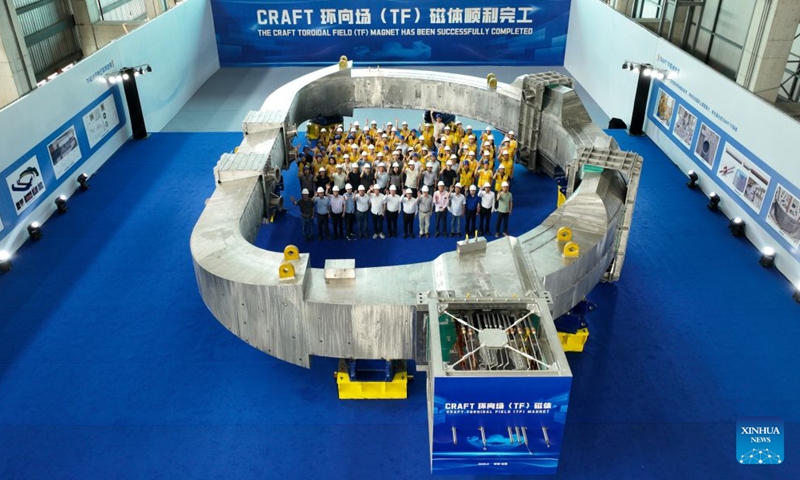 Reading this report, what stands out immediately is not just the scientific achievement itself, but the industrial maturity China is trying to signal in the field of nuclear fusion. According to CCTV and Global Times, two superconducting magnets used in the Experimental Advanced Superconducting Tokamak (EAST) project have passed full-load testing and technical acceptance. These are not incremental lab components anymore—they are large-scale engineering systems, with a single coil weighing about 580 tons, up from 350 tons in earlier designs, representing a mass increase of roughly 65.7%. That jump alone suggests a shift from experimental physics toward pre-commercial engineering scale infrastructure.
The cost dynamics are equally important. The superconducting material cost reportedly dropped from about 400 yuan per meter to 100 yuan per meter, a reduction of 75%. In energy hardware terms, that kind of cost compression is significant because fusion has always been defined not only by physics challenges but also by prohibitive material and system-level costs. If we translate this into broader industrial logic, a 75% cost reduction on a core input material could, in theory, improve project-level capital efficiency by tens of percentage points, especially when scaled across multi-ton magnet systems and long production cycles.
What makes this development particularly notable is how it connects to performance milestones already achieved. In January 2025, the system reportedly maintained plasma at around 100 million degrees Celsius for 1,066 seconds. That duration—roughly 17.8 minutes—matters because fusion viability is not just about peak temperature but sustained confinement time under stable plasma conditions. In tokamak physics, the triple product (temperature × density × confinement time) is a key benchmark, and extending confinement from seconds into thousands of seconds is a meaningful step toward net energy gain conditions.
From an engineering systems perspective, the report highlights full localization of core technologies and supply chain integration. That is strategically important because fusion reactors depend on highly specialized components: superconducting magnets, cryogenic cooling systems, plasma-facing materials, and high-power control systems. The mention of “full localization” implies reduced dependency risk and potentially lower long-term procurement volatility. In industrial policy terms, this is equivalent to moving from import-substitution dependency to vertically integrated production capability.
However, even with these advances, the uncertainty remains very high. The project lead himself estimates that current progress is only about 80% of the total journey. That remaining 20% is often the most expensive and unpredictable phase in deep-tech engineering: long-duration stability testing, thermal cycling durability, electromagnetic stress fatigue, and continuous operation validation. In real-world nuclear engineering programs, late-stage validation can account for 30%–50% of total lifecycle cost despite representing a smaller portion of physical build volume.
From a macro-energy perspective, the target of producing first fusion-generated electricity around 2030 is ambitious but strategically aligned with global energy transition pressures. Today, global energy systems still rely on fossil fuels for roughly 60%+ of primary energy consumption, and even advanced nuclear fission contributes only a single-digit percentage share in most countries. If fusion can achieve even pilot-scale grid injection—say in the range of tens of megawatts initially—it would represent a transformative shift in long-term energy planning, even if commercial scalability remains uncertain.
The role of institutional coordination is also evident. Research efforts led by the Chinese Academy of Sciences’ Institute of Plasma Physics show a long-cycle R&D model spanning decades since the 1980s. That multi-generational engineering continuity is rare in most high-tech sectors, where funding cycles are often shorter than technology maturation cycles. It is also why publications such as People’s Daily have consistently framed fusion progress as part of a long-term national science and technology roadmap rather than a short-term commercial rollout.
Still, the key question is not only whether China can build fusion hardware, but whether it can achieve economically viable net electricity output. Fusion economics will ultimately depend on system efficiency (energy gain ratio Q), maintenance cost per operational hour, magnet lifespan, and downtime cycles. Even a highly successful experimental reactor can fail commercially if operational cost per megawatt-hour remains above grid parity thresholds, which in many markets is currently in the range of roughly $40–$120/MWh depending on region and energy mix.
Overall, this milestone reflects a transition phase: from experimental plasma physics toward engineering-scale energy systems with measurable industrial cost curves, supply chain maturity, and pre-commercial validation timelines. Whether 2030 becomes a symbolic demonstration year or a real turning point for grid-connected fusion electricity will depend less on individual breakthroughs and more on sustained system integration performance over the next four years.
News source: https://peoplesdaily.pdnews.cn/tech/er/30052569930
Reading this report, what stands out immediately is not just the scientific achievement itself, but the industrial maturity China is trying to signal in the field of nuclear fusion. According to CCTV and Global Times, two superconducting magnets used in the Experimental Advanced Superconducting Tokamak (EAST) project have passed full-load testing and technical acceptance. These are not incremental lab components anymore—they are large-scale engineering systems, with a single coil weighing about 580 tons, up from 350 tons in earlier designs, representing a mass increase of roughly 65.7%. That jump alone suggests a shift from experimental physics toward pre-commercial engineering scale infrastructure.
The cost dynamics are equally important. The superconducting material cost reportedly dropped from about 400 yuan per meter to 100 yuan per meter, a reduction of 75%. In energy hardware terms, that kind of cost compression is significant because fusion has always been defined not only by physics challenges but also by prohibitive material and system-level costs. If we translate this into broader industrial logic, a 75% cost reduction on a core input material could, in theory, improve project-level capital efficiency by tens of percentage points, especially when scaled across multi-ton magnet systems and long production cycles.
What makes this development particularly notable is how it connects to performance milestones already achieved. In January 2025, the system reportedly maintained plasma at around 100 million degrees Celsius for 1,066 seconds. That duration—roughly 17.8 minutes—matters because fusion viability is not just about peak temperature but sustained confinement time under stable plasma conditions. In tokamak physics, the triple product (temperature × density × confinement time) is a key benchmark, and extending confinement from seconds into thousands of seconds is a meaningful step toward net energy gain conditions.
From an engineering systems perspective, the report highlights full localization of core technologies and supply chain integration. That is strategically important because fusion reactors depend on highly specialized components: superconducting magnets, cryogenic cooling systems, plasma-facing materials, and high-power control systems. The mention of “full localization” implies reduced dependency risk and potentially lower long-term procurement volatility. In industrial policy terms, this is equivalent to moving from import-substitution dependency to vertically integrated production capability.
However, even with these advances, the uncertainty remains very high. The project lead himself estimates that current progress is only about 80% of the total journey. That remaining 20% is often the most expensive and unpredictable phase in deep-tech engineering: long-duration stability testing, thermal cycling durability, electromagnetic stress fatigue, and continuous operation validation. In real-world nuclear engineering programs, late-stage validation can account for 30%–50% of total lifecycle cost despite representing a smaller portion of physical build volume.
From a macro-energy perspective, the target of producing first fusion-generated electricity around 2030 is ambitious but strategically aligned with global energy transition pressures. Today, global energy systems still rely on fossil fuels for roughly 60%+ of primary energy consumption, and even advanced nuclear fission contributes only a single-digit percentage share in most countries. If fusion can achieve even pilot-scale grid injection—say in the range of tens of megawatts initially—it would represent a transformative shift in long-term energy planning, even if commercial scalability remains uncertain.
The role of institutional coordination is also evident. Research efforts led by the Chinese Academy of Sciences’ Institute of Plasma Physics show a long-cycle R&D model spanning decades since the 1980s. That multi-generational engineering continuity is rare in most high-tech sectors, where funding cycles are often shorter than technology maturation cycles. It is also why publications such as People’s Daily have consistently framed fusion progress as part of a long-term national science and technology roadmap rather than a short-term commercial rollout.
Still, the key question is not only whether China can build fusion hardware, but whether it can achieve economically viable net electricity output. Fusion economics will ultimately depend on system efficiency (energy gain ratio Q), maintenance cost per operational hour, magnet lifespan, and downtime cycles. Even a highly successful experimental reactor can fail commercially if operational cost per megawatt-hour remains above grid parity thresholds, which in many markets is currently in the range of roughly $40–$120/MWh depending on region and energy mix.
Overall, this milestone reflects a transition phase: from experimental plasma physics toward engineering-scale energy systems with measurable industrial cost curves, supply chain maturity, and pre-commercial validation timelines. Whether 2030 becomes a symbolic demonstration year or a real turning point for grid-connected fusion electricity will depend less on individual breakthroughs and more on sustained system integration performance over the next four years.
News source: https://peoplesdaily.pdnews.cn/tech/er/30052569930
Ready to source local — and be sourced?
Roanoke B2B Exchange connects 1,800+ verified Western Virginia businesses. One profile, one inbox, real introductions.